Diastasis Recti Postpartum: Symptoms, Diagnosis, and Treatment Options
If you've made it to this blog, I've got you covered on everything you need to know about diastasis recti postpartum, including symptoms, how it's assessed and diagnosed, and conservative treatment options.
So, here's the plan. We're going to pretend like we're sitting in our favorite local coffee shop. I'm sipping on an iced latte with whole milk and honey, you're sipping on your favorite coffee shop drink, and we're going to chat about everything you need to know about postpartum diastasis recti, including symptoms, how it's diagnosed, and conservative treatment options.
What Is Diastasis Recti?
Diastasis recti is the separation of the rectus abdominis muscles, which typically occurs during late-term pregnancy.
The rectus abdominis muscles attach to the linea alba, which is a dense fascial structure that runs along the midline of the abdomen. During pregnancy, these muscles can separate in width as the abdomen expands.
This separation is typically most noticeable around the belly button. However, when assessing diastasis recti postpartum, most pelvic floor physical therapists will measure the separation at three different locations: directly at the belly button, above the belly button, and below the belly button.
Why Diastasis Recti Happens During Pregnancy
One thing I want to make really clear is that diastasis recti is a normal physiological change that happens during late-term pregnancy. In fact, we actually want this to happen!
Think about it. Your abdomen has to make room for a growing baby, and diastasis recti is one of the ways your abdominal wall accommodates that growth.
If the abdominal wall doesn't have a little bit of give, something else has to compensate, and that is often the pelvic floor. This can increase the pressure placed on the pelvic floor and potentially contribute to pelvic organ prolapse.
So, while diastasis recti postpartum is often talked about as something negative, the separation itself is actually a normal adaptation during pregnancy that allows your body to make room for your growing baby.
Signs and Symptoms of Diastasis Recti Postpartum
There are several signs and symptoms of diastasis recti postpartum that you may notice, including:
Core weakness
Low back pain
Coning or doming of the abdominal wall
Diastasis recti can also occur alongside other abdominopelvic conditions, including pelvic organ prolapse and stress urinary incontinence.
It's important to remember that these symptoms and conditions can occur together, but that doesn't necessarily mean diastasis recti is the cause of them.
How to Check for Diastasis Recti
You can actually check for diastasis recti at home, and it's relatively simple to do!
Start by lying on your back. Cross one arm over your chest toward your opposite shoulder, almost like you're getting ready to do a crunch.
Place your fingers at your belly button. Take your index finger and middle finger, place them together side by side, and position them directly in your belly button (umbilicus).
Perform a small crunch. Lift your shoulders just slightly off the surface you're lying on, keeping your fingers positioned at your belly button.
Measure the separation. As you crunch up, feel for the width between your rectus abdominis muscles. You're looking to see whether the separation is greater than two finger widths.
Repeat above and below your belly button. Perform the same assessment approximately two centimeters above your belly button and two centimeters below your belly button.
Typically, the separation is greatest directly at the belly button.
This is a simple way to check for diastasis recti postpartum at home, although a pelvic floor physical therapist can perform a more thorough assessment.
Does Diastasis Recti Heal on Its Own?
Sometimes, yes! Diastasis recti can improve on its own postpartum, but here's something I think is really important to understand: core strength typically doesn't just return on its own. It has to be intentionally trained.
Whether or not diastasis recti improves on its own depends on several factors, including the symptoms you're experiencing, the severity of the separation, and not only the width of the separation but also the depth.
Other factors include your activity levels prior to pregnancy and the genetic composition of your connective tissue, specifically your tissue elasticity.
So, while some women may experience improvement in their diastasis recti postpartum without intervention, rebuilding core strength is something that typically requires intentional exercise and training.
How Diastasis Recti Affects Core and Pelvic Floor Function
One thing I think is really important to understand is that your pelvic floor is actually part of a much larger unit, which is your core.
I like to explain this using a house analogy. Think of your pelvic floor as the foundation of the house, your abdominal muscles as the walls, and your diaphragm as the roof.
All of these muscles work together, or at least they should!
When you inhale, your diaphragm and pelvic floor should both descend. When you exhale, they should both lift, and your abdominal muscles should contract.
Essentially, these muscles should be working together as one coordinated unit.
When diastasis recti is present postpartum, we often see that these muscles aren't working together as efficiently as they should. Because of this, other symptoms or diagnoses related to the same underlying core and pelvic floor dysfunction may also be present.
Two common examples include:
Stress urinary incontinence: Urinary leakage that occurs with activities like laughing, jumping, coughing, or sneezing.
Pelvic organ prolapse: The descent of one or more pelvic organs into the vaginal wall.
It's important to understand that diastasis recti doesn't necessarily cause these conditions. Rather, they can occur alongside one another because of underlying dysfunction in how the core and pelvic floor muscles work together.
Exercises That Can Help Diastasis Recti
When it comes to exercises for diastasis recti postpartum, I typically like to start with the basics and work from there.
Some great starting exercises include:
Diaphragmatic breathing: Learning how to properly coordinate your breathing with your abdominal muscles and pelvic floor.
Transverse abdominis retraining: Retraining your deep abdominal muscles to contract and work together with the rest of your core.
Pelvic floor coordination: Learning how to both relax and contract your pelvic floor muscles and coordinate those movements with your breathing.
For example, when you inhale, you want your pelvic floor and abdominal muscles to relax. When you exhale, you want your pelvic floor and abdominal muscles to contract.
These are very much starting-place exercises, though! Diastasis recti rehabilitation shouldn't stop with breathing and basic abdominal contractions.
As you progress, other beneficial exercises include those that challenge your obliques and lats. I also like to assess the hamstrings because, sometimes, tightness or dysfunction in the hamstrings can affect your posture, which can ultimately impact your diastasis recti.
The goal is to retrain your abdominal muscles to work together as a coordinated unit while progressively rebuilding core strength.
When to See a Pelvic Floor Physical Therapist
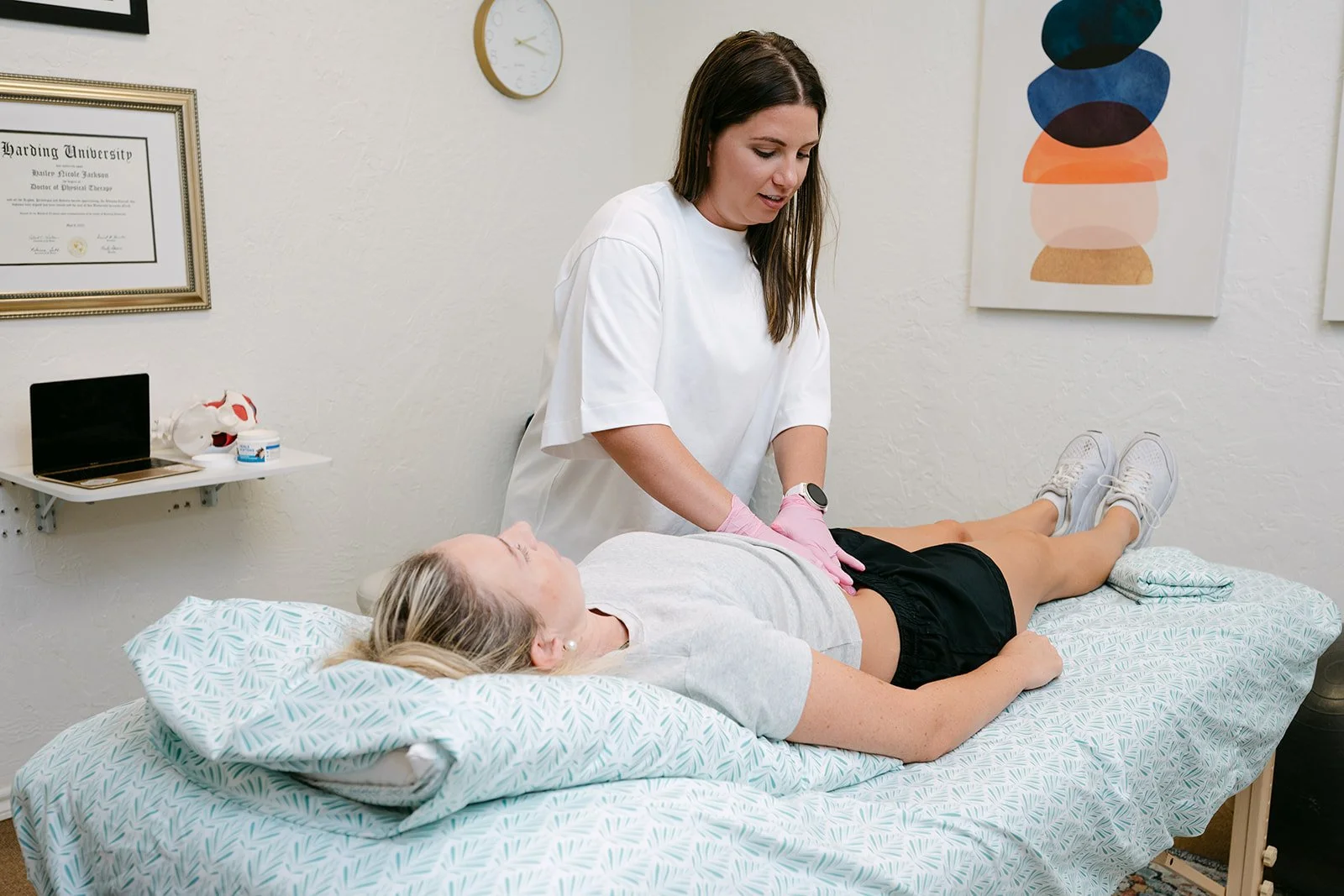
If you feel like you have a weak core postpartum, I would recommend starting pelvic floor physical therapy sooner rather than later.
I'm a huge believer in early intervention, and pelvic floor physical therapy can truly be life-changing, especially if your core weakness or diastasis recti is impacting your day-to-day life and activities.
And honestly, for most of my patients, it is!
You don't have to wait until your symptoms become severe to seek help. If you're struggling with core weakness or symptoms related to diastasis recti postpartum, I would encourage you to seek pelvic floor physical therapy sooner rather than later.
If you're curious about what pelvic floor physical therapy looks like, you can read more on our What to Expect page.
Ready to Start Pelvic Floor Physical Therapy?
If you're postpartum and wanting to begin pelvic floor physical therapy for any of the symptoms or concerns we've talked about in this blog, good news! We are currently accepting new patients in East Texas!
We have offices in Sulphur Springs, Canton, and Rockwall, and we would love to help you along your postpartum recovery journey.
If you're interested in scheduling an appointment, you can call our office directly at 903-962-2600 or submit a form here to request an appointment.
If you'd like to learn more about what your first appointment will look like, you can also read our What to Expect page.