C-Section Recovery: What to Expect
If you made your way to this blog, I’m assuming you or someone you love has recently experienced a C-section. Unfortunately, I have found that most of the patients I see in clinic are not given very much information about what recovery following a cesarean section actually looks like.
So, I’m going to pretend like we are sitting together at my favorite local coffee shop, you with your favorite drink of choice and me with my iced latte with whole milk and honey, and I’m going to tell you everything you need to know about C-section recovery. We’ll talk about what you can expect to feel, what recovery may look like, and some general recommendations around healing and recovery after a C-section.

Early C-Section Recovery and Managing Pain and Discomfort
During early C-section recovery, one of the biggest things I recommend is staying on top of your pain medication and making sure you are drinking enough fluids.
Getting in and out of bed is probably going to be difficult for the first few weeks. Instead of trying to sit straight up, I recommend rolling onto your side first. From there, let your legs fall off the side of the bed or couch and use your arms to push yourself up. This can make getting up much more manageable during those early weeks.
Early mobility is also recommended. This doesn’t mean you need to push yourself through pain, but walking around as much as you comfortably can without causing or increasing pain can be helpful during recovery.
Incisional pain is very, very common after a C-section, but for most people, it should resolve by around eight weeks. Other symptoms that are common during this time include back pain, constipation, hemorrhoids, and urinary symptoms. Some of these symptoms may not be completely resolved by your first six-week postpartum visit, but shouldn’t be dismissed.
If you are experiencing incisional pain, I also think it’s important to pay attention to the type of pain you are having. Nerve pain is not something you should just have to live with. There are manual therapy techniques that can be used to help decrease nerve pain, which I often find is located a little higher up on the abdomen.
C-Section Scar Healing
Your C-section scar should be healed by around six to eight weeks. I do not recommend doing any of the things I’m about to talk about until you have been cleared by your OB, but once you are cleared, there are several things you can do to help improve the aesthetic, mobility, and sensation of your C-section scar.
One of my favorite things to use is cupping. You can get a cup from Amazon and use a little lotion or body butter on your abdomen. Squeeze the cup, place it on your skin, and then let go so that it suctions some of the skin into the cup. From there, you can gently slide the cup over the area where you applied the body butter.
I recommend starting farther away from your scar and gradually working your way toward it as your tolerance improves. Sometimes going directly over the scar can be a little much in the beginning, and that’s okay.
Silicone sheets are another option I recommend to help with the scar tissue and the aesthetic of the scar. I have the ones I recommend linked here. You simply peel the sheet and place it directly over your scar. Silicone sheets were originally intended for burn victims but have since been rebranded and marketed to women following C-sections.
Another thing I recommend is desensitization, especially if you are experiencing numbness or changes in sensation around your scar. Some of that numbness can actually improve by working on desensitization techniques.
For this, you want to use as many different textures as you can. Think washcloths, makeup brushes, blankets, towels, jeans, and different fabrics you already have throughout your house. Rub the different textures directly over your scar for around five minutes per day.
A lot of people notice that they have more numbness on one side than the other, so I often have patients work on one side at a time. Consistently working on desensitization can really help improve sensation in the area.
Lastly, lymphatic massage or traditional massage can also help improve scar mobility. If you are considering pelvic floor physical therapy in person, I also use dry needling directly in the scar, which can help quite a bit with scar tissue and mobility.
By six to eight weeks, your C-section scar should not be painful. If you are still experiencing pain around your scar at that point, that is something that should be addressed rather than something you just have to live with.
Returning to Daily Activities and Exercise After a C-Section
Everyone’s life looks different after having a baby. You may or may not have other kids at home. You may have toddlers you’re already chasing around. Some people have the luxury of being able to rest more than others, and I completely understand that.
With that in mind, here is the general C-section recovery timeline I recommend to my patients.
The First Two Weeks: Rest and Gentle Movement
For the first two weeks, I recommend resting as much as possible while still implementing a little bit of walking within your pain-free tolerance.
This is not the time to push yourself or worry about your endurance. Give your body time to heal while still getting up and moving around as you are able.
Around Four Weeks: Gradually Increase Activity
Around four weeks, you’re probably starting to come out of the postpartum bubble/fog a little bit more. I still wouldn’t push it endurance-wise, but this is when I would start gradually stretching out your walking and doing a little bit more around the house.
You can increase your walking distance just a little bit while continuing to pay attention to how your body feels.
Around Six Weeks: The Starting Line
Then we get to six weeks.
A lot of people who are used to participating in a structured exercise routine are very gung-ho about returning to exercise at six weeks postpartum. But I like to think of six weeks as the starting line, not as a “resume everything you were doing before pregnancy” kind of scenario.
At six weeks, I recommend doing a lot of walking and beginning some gentle core strengthening. I also like diaphragmatic breathing and exercises that require your full body to work together, like squats and deadlifts.
At this point, I don’t like to incorporate plyometrics or single-leg exercises yet. This stage should really be about gradually getting your body used to moving again.
Around Nine to Twelve Weeks: Progress Strengthening
Once you are in a good routine and you are starting to feel strong through your core, usually around nine to twelve weeks, I like to begin incorporating more single-leg exercises.
This is especially important if your goal is to eventually return to running. I like to use single-leg strengthening as a precursor to plyometrics and then, eventually, running.
If walking and strength training are your goals, great. Your progression doesn’t have to include running or plyometrics.
What to Focus on Throughout Your Recovery
Something I think is really important for postpartum women, whether you had a C-section or a vaginal birth, is working on isolated glute strengthening and diaphragmatic breathing.
Because of the way your body changes during late pregnancy, your glutes have a tendency to stop wanting to work and fire the way they normally would. A lot of women then begin compensating in other areas of their body, and the pelvic floor is a very common place for that compensation to happen.
The same thing can happen with your breathing patterns. During late-term pregnancy, you don’t have the same ability to breathe using your true diaphragm, so you tend to breathe more through your upper ribs. If that breathing pattern is never retrained during the postpartum period, you may simply continue with that habit, and it isn’t always beneficial for your pelvic floor.
Taking the time to really isolate and retrain your diaphragm and your glutes can go a long way in your postpartum return to exercise journey.
Core and Pelvic Floor Recovery After a C-Section
There is a myth that having a C-section protects you from experiencing pelvic floor dysfunction, and that is simply not true. Pelvic floor dysfunction after a C-section can just look a little different.
Women who have had C-sections may experience things like pain with sex, scar pain, core weakness, urinary urgency and frequency, and constipation. These are all things I would be on the lookout for during your C-section recovery. If you are experiencing any of these symptoms, know that there is help available through pelvic floor physical therapy.
As far as what I recommend to my patients in the clinic who have had C-sections, I always start with diaphragmatic breathing and the deep core.
The first step is learning how to engage your deep core when you exhale while also learning how to relax your pelvic floor when you inhale. Honestly, the relaxing part is usually the hardest part. There is a lot of mind-body connection involved with both your core and pelvic floor.
Think about it like this:
Inhale: Relax your core and relax your pelvic floor.
Exhale: Engage your core and engage your pelvic floor.
Once you have that coordination down, you can start incorporating it into movement. For example, when doing a squat or deadlift, inhale as you lower down and exhale as you come back up.
When it comes to postpartum core strengthening, I honestly don’t love sit-ups. I prefer exercises that target the obliques and deep core, like lateral planks, hip dips, bird dogs, and dead bugs. Planks are okay too, but make sure you are actually breathing while you’re holding your plank rather than holding your breath.
If I had to tell you one thing to prioritize when it comes to your core and pelvic floor postpartum, it would be your breathing… Your breathing mechanics are the first and foremost thing I would recommend working on.
When Pelvic Floor Physical Therapy Can Help After a C-Section
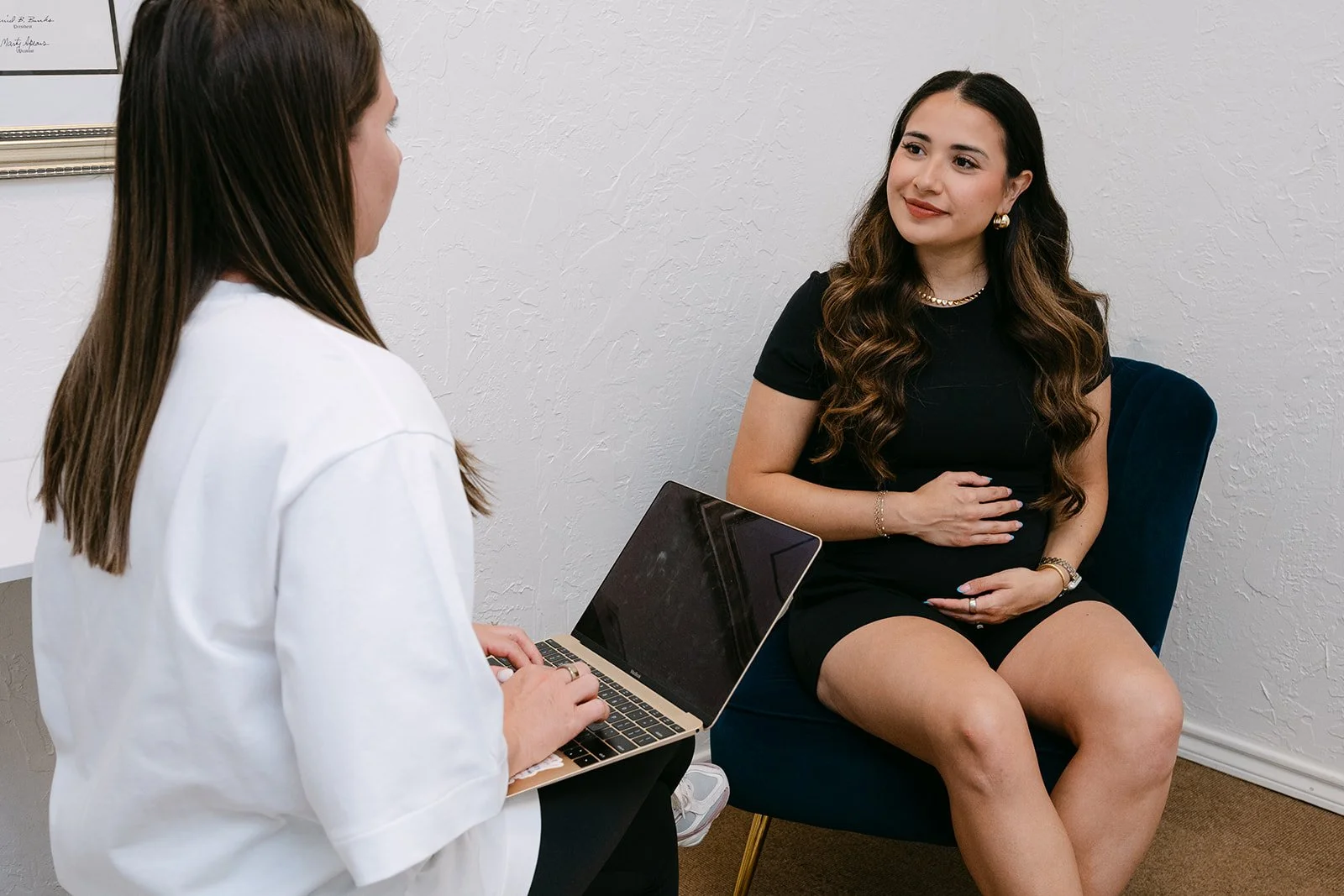
Pelvic floor physical therapy can help after a C-section whether you are experiencing symptoms or not.
Physical therapy can help with core strengthening, functional movement, returning to exercise, returning to intercourse, and really whatever your individual postpartum goals may be.
Some of the specific symptoms we see after C-sections include urinary urgency and frequency, pain with sex, urinary leakage, constipation, pain with bowel movements, general core weakness, pelvic floor tension, scar-related pain, and scar-related tension, among many other things.
If you are struggling with any of these symptoms after a C-section, please know that there is help available through pelvic floor physical therapy. You don’t have to assume that something you are experiencing is simply part of postpartum recovery and something you have to continue living with.
If you’re local to East Texas, we have offices in Sulphur Springs, Canton, and Rockwall, and we would love to help you with your C-section recovery.
Ready to Get Started?
If you’re interested in scheduling an appointment, you can fill out a form here, and someone from our office will give you a call to get your appointment scheduled. Or, you can call our office directly at 903-962-2600.
We would be honored to help you along your C-section recovery journey.