When Can I Start Exercising After Birth? A Guide to Postpartum Exercise
If you’ve made your way to this blog, I would imagine you are postpartum, you enjoy exercise, and you’re trying to figure out when you can begin your return-to-exercise journey.
You may or may not be in the middle of the newborn fog right now, but either way, I see you, and I’ve got you. Let me help with the mental load of it all. We’re going to pretend like we’re sitting in my favorite local coffee shop, and I’ve got my iced latte with whole milk and honey. You’ve got your drink of choice, and we’re going to talk about when and how to begin your postpartum return-to-exercise journey.
We’re going to talk about recovery after both vaginal birth and C-section, because while those recovery journeys can look different, there are things to consider before returning to exercise after either type of birth.
What Happens to Your Body After Birth?
There are the obvious things that your body has to recover from after birth. C-section scars and the layers of tissue that were cut into and are now healing. Your uterus is healing. Perineal scars may be healing. Sometimes there are more involved injuries, like a tailbone fracture, or you may be recovering from significant blood loss if you hemorrhaged.
Giving birth is a major event, and there is a lot of tissue recovery that goes into healing. A lot of the medical guidance you hear about when you can start exercising after birth is based on those tissue-healing timelines.
If you’re new around here, I’m a physical therapist, so the majority of what I’m going to talk about comes from a musculoskeletal and neuromuscular perspective. We’re talking about muscles, tendons, ligaments, musculotendinous junctions, and orthopedic concerns, if you will.
Think about it this way: the changes that happen to your body during pregnancy occur gradually over nine to ten months for most people. Your center of gravity changes significantly. Your posture changes significantly. Before pregnancy, imagine a general standing posture where your toes point forward, your ribs are stacked over your pelvis, and your back is relatively straight.
During pregnancy, your hips naturally rotate out a little more. Your growing abdomen pulls everything forward, and your glutes may not work as well, forcing other muscles to compensate. The adductors and pelvic floor muscles are often two of those compensatory muscle groups.
Another major musculoskeletal change happens at your rib cage. As your baby grows up into your ribs during the second and third trimesters, the bottom of your rib cage has to expand quite a bit. This flattens your diaphragm and changes your breathing patterns. You’re forced to breathe higher into your upper ribs.
Then you give birth, and your center of mass changes pretty quickly because your baby is no longer sitting in your abdomen. But those musculoskeletal changes we just talked about don’t necessarily change as quickly.
If those things aren’t intentionally addressed during the postpartum period, they can easily get overlooked and may hinder your return-to-exercise journey for quite a while. Your center of gravity has changed, but if the musculoskeletal changes that happened during pregnancy aren’t addressed, then they’re simply not addressed.
When Can You Start Moving Again?
Most postpartum patients are cleared for exercise at their six-week postpartum appointment. But I think it’s important to keep in mind that exercise is subjective.
Some women love long walks. Some women love CrossFit. Some women love Pilates. And others want their return to movement to be very, very gentle.
In my world, I view movement as medicine first. Breathing exercises, deep core exercises, and glute stability work are all movement, even though they can be incredibly gentle. I actually think it can be appropriate to begin some of these things as early as two to three weeks postpartum if that is something you desire.
So, when can you start exercising after birth? Here is my proposed timeline for gradually easing back into movement, provided there were no major injuries during birth, like a tailbone fracture or labral tear:
2–3 weeks postpartum: Begin gentle, symptom-free walks and breathing exercises.
4–5 weeks postpartum: Start walking a little farther or gradually pushing your walks out, while continuing to stay within a symptom-free capacity.
6–8 weeks postpartum: Once you have been cleared, I recommend beginning bodyweight strengthening exercises.
Around 8–10 weeks postpartum: After giving bodyweight exercises a couple of weeks, begin adding weighted exercises in a lighter capacity and gradually progress from there.
The big thing I want you to take away from this timeline is that returning to exercise after birth does not have to mean going from resting to your normal workout the second you hit six weeks postpartum. There is plenty of movement you can begin with before that point, and your return to exercise can be gradual.
Common Symptoms With Exercise After a Vaginal Birth
There are several symptoms that I commonly see in patients who are beginning their return-to-exercise journey after a vaginal birth. Some of the most common include:
Pelvic heaviness or pressure
Core weakness
Urinary leakage with activities like squatting, jumping, or running
Hemorrhoids
Constipation
Incomplete emptying of the bladder or bowels
Pain with intercourse, including both insertional pain and pain with deep penetration
These are some of the most common symptoms I see in patients recovering from a vaginal birth.
Common Symptoms After a C-Section
Just like with a vaginal birth, there are several symptoms that I commonly see in patients recovering from a C-section. Some of the most common include:
Pain with intercourse
Urinary urgency and frequency
Core weakness
Pelvic pain
These are some of the most common symptoms I see in patients recovering from a C-section.
Signs Your Body Needs More Time
One of the biggest things I want you to pay attention to as you begin exercising after birth is how your body responds to movement.
Any of the symptoms we talked about above can be a sign that your body needs a little more time, especially if you notice an increase in symptoms following exercise.
For example, if you notice an uptick in pelvic heaviness, pressure, urinary leakage, or pelvic pain after a workout, that may be your body’s way of telling you that you’re not quite ready for that level of activity.
And that doesn’t necessarily mean you need to stop exercising altogether! It may simply mean you need a little more time, a different approach, or even just to dial down the intensity of your workouts.
The goal is to gradually return to the activities you enjoy without making your symptoms worse along the way.
How Pelvic Floor Physical Therapy Can Help
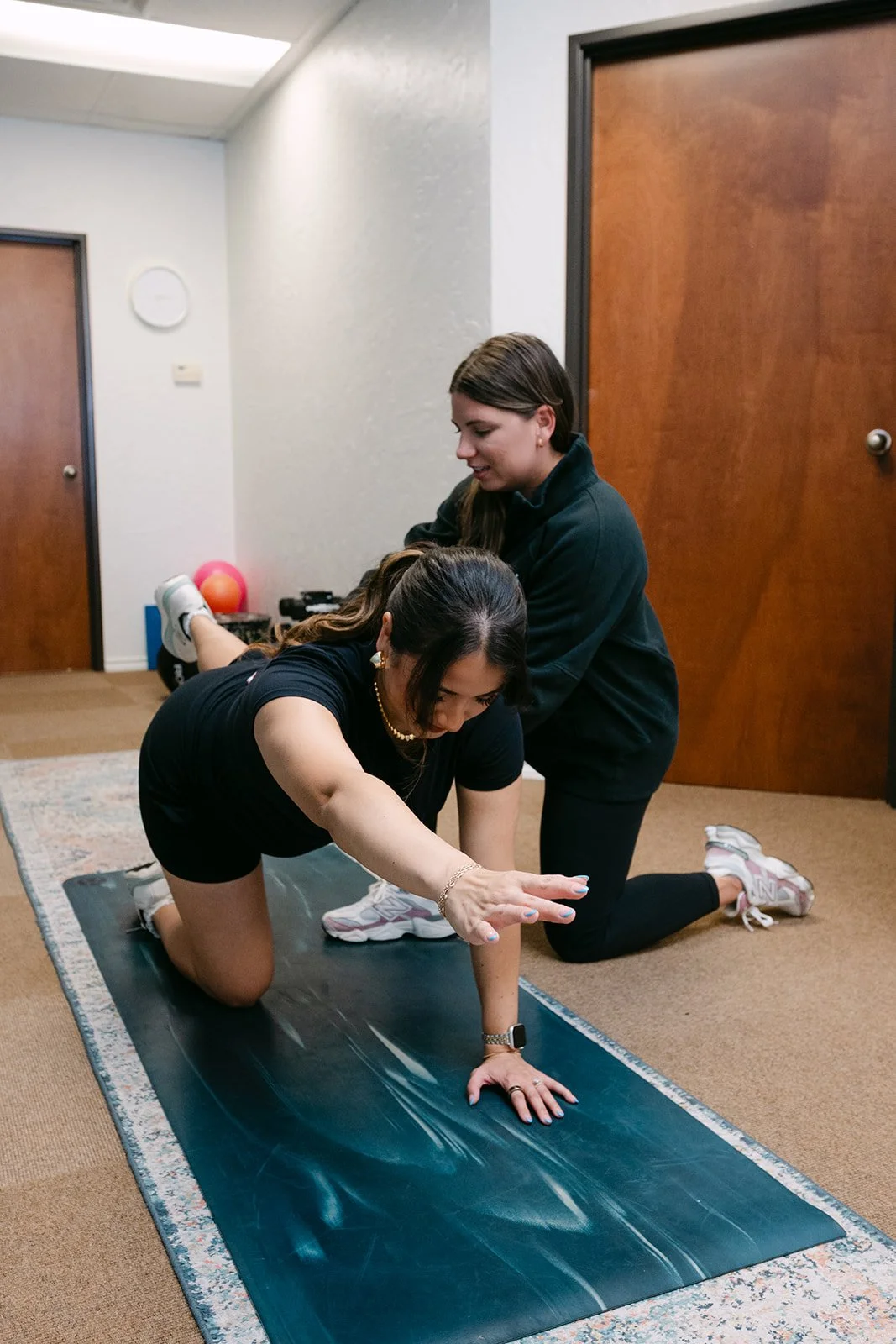
Pelvic floor physical therapy involves a thorough examination and assessment of your pelvic floor muscles. Your pelvic floor physical therapist should be able to tell you whether your pelvic floor muscles are tight, weak, or not coordinating appropriately. But more importantly, they should be able to tell you why your pelvic floor muscles are tight, weak, or not coordinating the way they should.
From there, they should be able to guide you through a very individualized, prescriptive exercise program that addresses whatever is going on with your pelvic floor, whether that’s tightness, weakness, or coordination deficits.
Pelvic floor physical therapy can help address any of the common symptoms I listed above. These are things we see and treat every single day at our clinic. And, surprisingly to many of our patients, a lot of these symptoms are actually coming from the pelvic floor muscles themselves!
The goal is to identify what’s going on, understand why it’s happening, and give you the tools and exercises you need to address it so you can confidently return to the activities you enjoy.
Ready to Begin Your Postpartum Return to Exercise Journey?
Good news! If you’re ready to begin your postpartum return-to-exercise journey and would like a little more structured, individualized guidance along the way, we would love to help you!
We are currently accepting new patients at Texas Pelvic Health in Sulphur Springs, Canton, and Rockwall, Texas.
If you’re interested in scheduling an appointment, you can fill out a form [here], and someone from our office will reach out to help you get scheduled. Or, you can call our office directly at 903-962-2600, and we would be happy to help you begin your postpartum return-to-exercise journey!