Peeing While Running: Why It Happens and What to Do About It
If you made your way to this blog, I’m going to assume there’s a good chance you’re peeing while running, and you’re wondering what you can actually do about it.
So, here’s what we’re going to do.
I want you to pretend we’re sitting together at my favorite local coffee shop, and I’m telling you everything I want you to know about peeing while running.
We’ll talk about why it happens, what might be contributing to it, and most importantly, give you a course of action to start improving it.
Let’s get into it.
Different Types of Urinary Leakage
Before we get into why you might be peeing while running, I want to start with the different types of urinary leakage, also known as urinary incontinence.
There are four main types of urinary incontinence: stress incontinence, urge incontinence, overflow incontinence, and functional incontinence.
Stress incontinence happens when a load or force is placed on the pelvic floor and the pelvic floor cannot overcome that force. This can look like leaking with sneezing, coughing, laughing, jumping, or other quick and forceful movements.
Peeing while running falls into this category.
Urge incontinence is different. This is the type of leakage that might happen when you’re on your way to the bathroom, when you walk through the door of your house, or when you hear running water.
Urge incontinence is treated differently than stress incontinence, which is why understanding what type of leakage you’re experiencing matters.
Overflow incontinence is often related to a neurological issue and isn’t something I treat as frequently. Essentially, someone may not feel the sensation that they need to go to the bathroom. Their bladder continues to fill until it eventually overflows, resulting in leakage.
And then there is functional incontinence, which I would categorize as a subcategory of stress incontinence.
This is leakage that happens during functional movements throughout your day, such as going from sitting to standing or deadlifting. Rather than happening with something quick and forceful like a cough, sneeze, or laugh, the leakage happens during a functional movement pattern.
For the purposes of this blog, we’re going to focus primarily on stress incontinence because that is the type of urinary leakage we’re typically talking about when someone is peeing while running.
The Role of the Pelvic Floor
Before we talk about why the pelvic floor can cause you to pee while running, it helps to understand what these muscles actually do.
The pelvic floor is a group of muscles deep within your pelvis. They sit somewhat like a hammock and need to be able to do several different things.
They need to contract slowly.
They need to contract quickly.
And they also need to be able to fully relax.
Your pelvic floor muscles are an autonomic group of muscles, meaning they should automatically contract in anticipation of a force being placed on them.
You shouldn’t have to consciously think, Okay, pelvic floor, contract now.
They should anticipate the force and respond appropriately.
When these muscles aren’t functioning the way they should, you can experience issues with peeing, pooping, sexual function, pain, and weakness.
And your pelvic floor has an especially important job when you’re running.
With every step you take, there is force being placed through the pelvic floor. At the same time, your pelvis requires a significant amount of stability because of how much of the running gait cycle is spent on one leg.
Your pelvic floor has to be able to respond to all of that, over and over again, throughout your run.
When it can’t respond appropriately, that’s when we can start to see problems like peeing while running.
Why Peeing While Running Happens
When someone comes to see me because they’re peeing while running, there are really three main categories I’m looking at:
Pelvic floor muscle weakness
Pelvic floor muscle tension
Pelvic floor muscle coordination issues
1. Pelvic Floor Muscle Weakness
Pure pelvic floor muscle weakness is actually not something I see very often in runners.
If I do see weakness, it is usually a secondary problem to pelvic floor muscle tension.
Basically, the pelvic floor muscles are working overtime. Because they are constantly working, they become fatigued. Then, when you actually need those muscles to respond to the demands of running, they don’t have the capacity to do what you need them to do.
So yes, the muscles may test weak, but that doesn’t necessarily mean that simply strengthening them is the answer.
2. Pelvic Floor Muscle Tension
Pelvic floor muscle tension is probably what I see most often in runners who are experiencing urinary leakage.
Your pelvic floor does not work in isolation. It responds to the muscles in your abdomen as well as the muscles and joints throughout your lower extremities.
With runners specifically, I will often find increased pelvic floor muscle tension on one side.
Essentially, one muscle or a group of muscles on one side of the pelvic floor is working overtime to provide stability because something else in the body isn’t stable.
Two of the most common things I see are glute instability and ankle instability.
That ankle sprain you had playing high school or collegiate sports that seemed pretty benign at the time?
It can come back in this regard.
The other big one is glute instability.
You have three glute muscles: the glute max, glute med, and glute min. The glute med plays an especially important role in providing stability to the pelvis when you’re on one leg.
And approximately 60% of the gait cycle is spent on one leg.
If your glute med isn’t firing when and how it needs to, your pelvic floor may start compensating. It begins doing a job it wasn’t designed to do, becomes overactive, and that can eventually contribute to leakage while you run.
3. Pelvic Floor Muscle Coordination Issues
The third category is a coordination problem, specifically how your pelvic floor coordinates with your core and diaphragm to manage pressure.
When you breathe in, your pelvic floor muscles should relax a little.
When you breathe out, your pelvic floor muscles should contract a little.
But if you are chronically tense and inhaling down, you can create more pressure on your pelvic floor.
And contents are always going to come out through the weakest link.
In this case, that weakest link is typically the pelvic floor, which can result in urinary leakage.
For someone experiencing this type of issue, working on the coordination between the pelvic floor, core, and diaphragm can typically help solve the problem.
This is also why figuring out why you’re peeing while running matters. Weakness, tension, and coordination deficits are three different problems, and they don’t necessarily need the same solution.
Common Triggers During a Run
Sometimes you may notice that you’re not peeing throughout your entire run. Instead, there are certain things that seem to trigger the leakage.
A few common triggers I see are hills, fluid consumption, and constipation.
Hills
Sometimes going uphill or downhill can trigger urinary leakage.
If you notice that you’re fine on flat ground but start leaking as soon as you hit a hill, that’s something worth paying attention to.
Fluids
I always look at fluid consumption when one of my patients is leaking with exercise, not just running.
One thing I commonly see is someone who stops drinking water because they’re afraid it will make the leakage worse, but they’re still drinking other fluids.
Coffee. Tea. Energy drinks. Pre-workout. Drinks with artificial sweeteners.
These can all be bladder irritants, meaning they irritate the lining of the bladder and can increase leakage, especially if you’re also dehydrated.
Something I recommend is what I call water sandwiching.
Drink some water, consume your coffee, pre-workout, or other bladder irritant, and then drink more water afterward.
The goal is simply to help dilute that bladder irritant in your bladder.
This is especially important for runners because I often find that someone is drinking coffee or pre-workout right before exercising and then wondering why their bladder suddenly seems much more irritated during their run.
Constipation
Constipation is another trigger I always want to consider.
Your rectum sits right on top of the pelvic floor. If your rectum is full of stool and then you’re asking your pelvic floor to activate and function appropriately during a run, it’s going to have a much harder time doing its job.
So if you’re peeing while running, we don’t want to look at the running itself in isolation.
We also need to look at what you’re drinking, your bowel habits, and even when during your run the leakage tends to happen.
What to Do About Peeing While Running
So, what do you actually do about peeing while running?
It completely depends on why you’re experiencing it in the first place.
If you’ve read this far, you probably realize there are a lot of different reasons you could be experiencing urinary leakage while running.
The first step is figuring out what is contributing to your leakage and then addressing that specific issue.
Here are some of the things we’ve talked about so far that I want you to consider:
Pelvic floor weakness: Your core may feel weak overall. You might also experience back pain or, if you’re postpartum, you may have diastasis.
Pelvic floor overactivity: Your pelvic floor muscles may be working overtime rather than simply being weak. You may also experience pain along with the leakage.
Pelvic floor coordination and pressure issues: Do you hold your breath? Do you have absolutely no idea how to relax your pelvic floor? You may also have decreased rotation through your mid-spine while you run.
Then we have some of the other things we’ve talked about.
Are you constipated?
Are you consuming a lot of bladder irritants?
Does your leakage happen primarily when you’re running hills?
Once you start identifying the why, you can start addressing that specific problem.
For example, if you notice that you leak significantly more when running up and down hills, try running on a flat surface for a while. Build your endurance there, and then gradually start adding hills back into your runs.
If constipation is contributing, address the constipation.
If you’re drinking coffee or pre-workout before every run and not drinking much water, start looking at your fluid consumption.
The answer isn’t necessarily to stop running.
And it’s also not necessarily to just start doing more pelvic floor strengthening exercises.
Figure out why you’re peeing while running, address the thing that is contributing to it, and then gradually build your body’s capacity from there.
When to Seek Professional Support
If you’ve read any of my other blogs, you probably already know that I am a huge advocate for earlier is better.
So if you’re peeing while running, I think it’s appropriate to seek professional help now.
You don’t have to wait until the leakage gets worse or until it starts keeping you from running altogether.
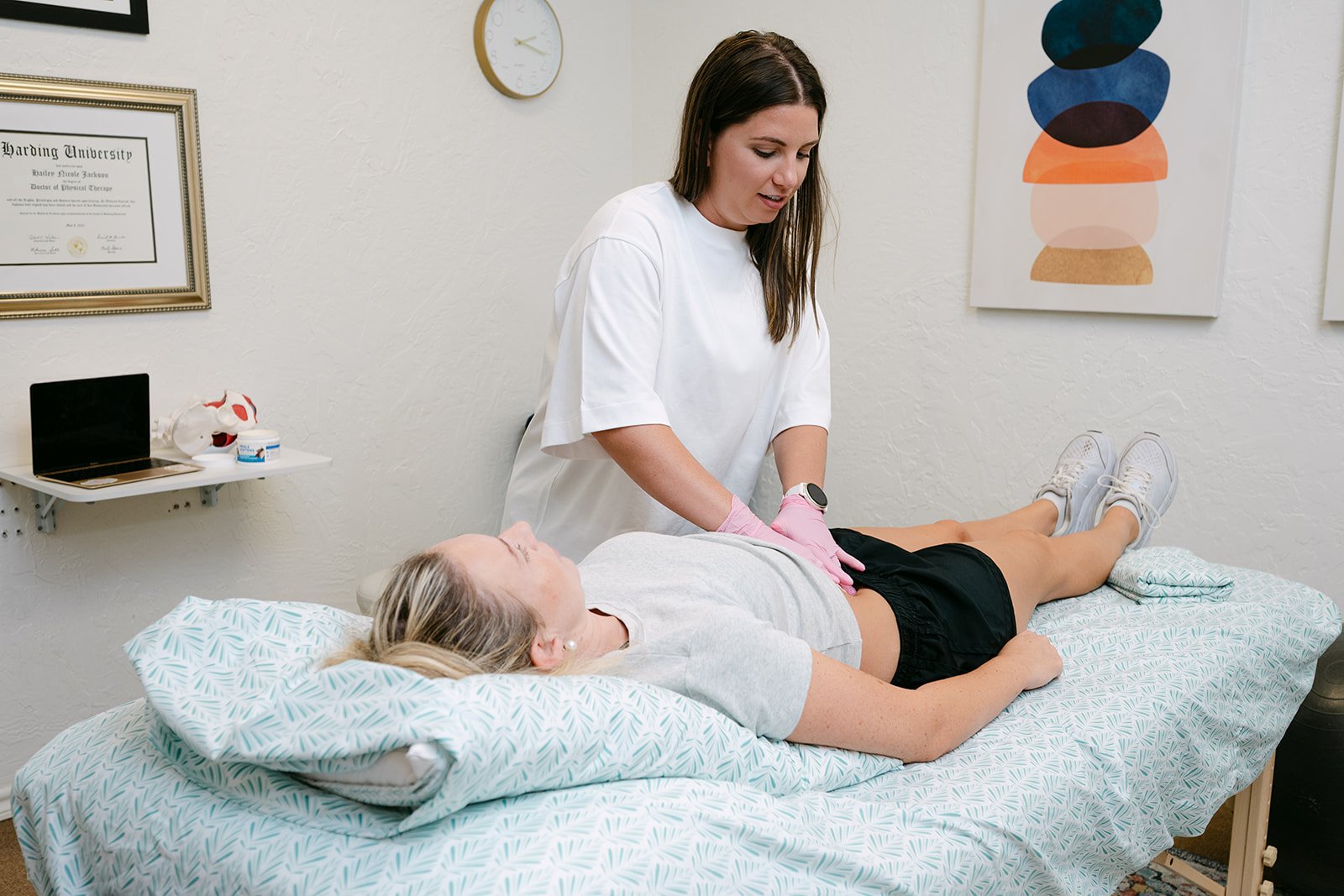
A pelvic floor physical therapist can help you figure out why you’re experiencing leakage in the first place and then determine what needs to be addressed based on what is going on in your body.
If you have a pelvic floor physical therapist in your area, that’s a great place to start.
We also see clients virtually, so if you don’t have access to a pelvic floor physical therapist near you, working with us virtually may be an option.
And if you’re local to East Texas, we are currently accepting new patients at our Canton, Rockwall, and Sulphur Springs locations.
We would love to help you get back to running without worrying about leakage.
If you’d like to schedule an appointment, you can submit the contact form here or call our office at 903-962-2600, and someone from our team will be happy to get you scheduled.